
Data leaks in France in 2026: why the risk keeps worsening and how to defend yourself
Clermont-Ferrand, May 1, 2026
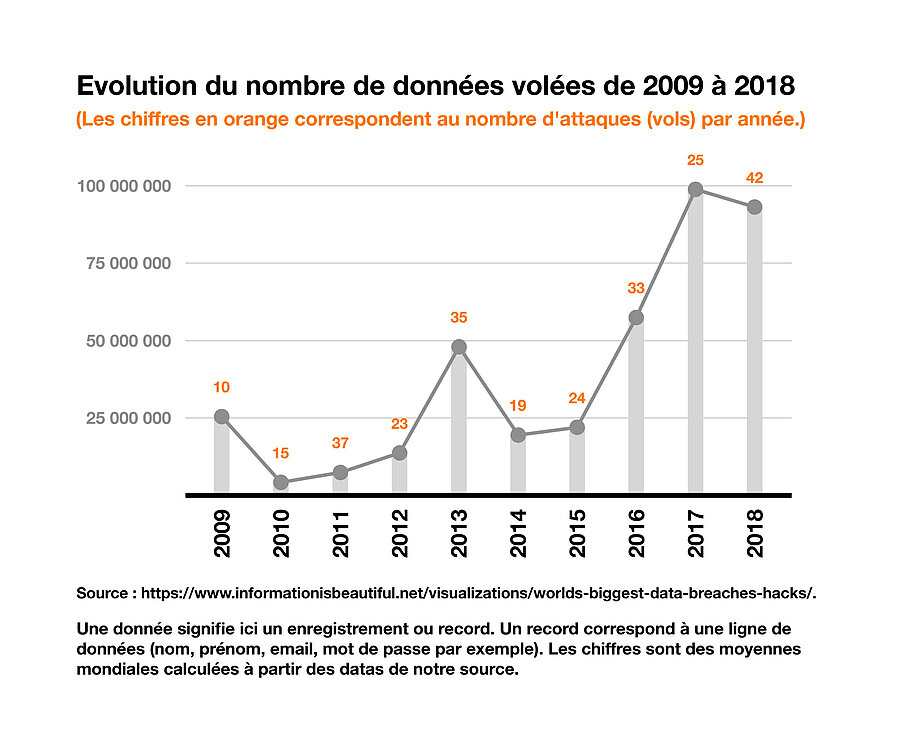
Q1 2026 confirmed a worrying tipping point: France now ranks second in the world among countries most affected by data breaches, with about 23.5 million accounts compromised in the first three months of the year, just behind the United States. Since January, more than 300 services and platforms operating in France have been hit and nearly 250 million data records reportedly exposed. This dynamic — observed by several monitoring centers and confirmed by the 20% increase in breach notifications received by the CNIL in 2024 — is no longer explained solely by an intensification of attacks: it reflects a change in the nature of incidents, now industrialized, automated and increasingly targeted at supply chains.
The examples of recent months illustrate the scale of the phenomenon. The French Office for Immigration and Integration (OFII) saw, on January 1, the data of 2.1 million foreign-national files exfiltrated. A few weeks later, software vendor Cegedim Santé was hit, exposing the information of nearly 15 million insured persons. URSSAF, in turn, acknowledged a fraudulent access potentially affecting 12 million people, with particularly sensitive data: names, dates of birth, employer SIRET numbers and hire dates. The ManoMano leak in late January was a reminder that the weak link is often a subcontractor, here a customer-service provider. On the regulator side, the CNIL hit hard: €42 million in fines imposed in January on FREE and FREE MOBILE following the October 2024 attack that compromised 24 million subscriber contracts and their IBANs, and €5 million on France Travail for failing to secure jobseeker data.
Why the risk is worsening: a compounding effect
Three forces combine to explain this acceleration. The first is the mechanical growth of the attack surface. Companies store more data, multiply their SaaS, integrate partners via API and connect a growing number of devices to their information system. Every integration is a dependency, and every dependency can become an exfiltration vector. The second is the industrialization of attacks by cybercrime groups, who themselves feed off prior leaks to rebuild credential databases, fuel credential-stuffing campaigns and automate target reconnaissance. The third is legal: with the transposed NIS2 directive and the strict application of GDPR, the cost of a breach is no longer limited to technical damage. It now includes financial sanctions, class actions, individual notification costs and reputational impact, particularly heavy for service companies and software vendors.
Concrete blind spots to watch
Beyond the general talk on digital hygiene, several blind spots stand out from the most reported 2026 incidents. The first concerns privileged accounts and admin access: the CNIL now explicitly requires multifactor authentication on these accounts, and several recent sanctions were motivated by its absence. The second is encryption of data at rest and in transit, now a non-negotiable standard for the CNIL whenever sensitive personal data is involved. The third is the supply chain: a poorly secured subcontractor becomes a privileged entry point, and the data controller remains legally accountable for the data entrusted to a third party. The fourth concerns logging and detection: too many organizations discover the incident weeks after the fact, sometimes via the press, due to a lack of continuous supervision. Finally, excessive data retention — old files, forgotten backups, test environments populated with real data — multiplies exposed volumes with no operational benefit.
How to defend yourself: seven structuring habits
Map your processing operations and data flows, identify the most sensitive datasets, and restrict access to the strict minimum based on the principle of least privilege.
Enforce multifactor authentication on every admin access, remote or not, and reinforce user passwords with regularly audited length and complexity rules.
Systematically encrypt data at rest on servers and roaming endpoints, as well as flows in transit, internally and externally.
Put in place continuous operational supervision capable of detecting abnormal behavior, large-volume exfiltrations and credential-stuffing compromises.
Audit your subcontractors, contractually impose concrete security commitments and require regular proof of their application, especially for providers accessing personal data.
Run regular intrusion tests on exposed perimeters but also on partner portals and critical internal applications.
Actively monitor the presence of organizational data on the darkweb to detect a leak before it makes the news and anticipate notification and remediation actions.
SYLink Technologie's solutions for companies and their suppliers
SYLink Technologie has structured its offering around this defense-in-depth logic, prioritizing data sovereignty and operability by internal teams. SYLink Box ensures network segmentation, deep flow inspection and encryption of inter-site communications, applicable to a headquarters and a remote worker alike. SYLink Audit produces court-admissible reports aligned with NIS2, ISO 27001, HDS and PSSIE requirements, usable by an executive or an auditor. SYLink Pentest automates continuous intrusion testing, with no cloud callback, to verify the real exposure of an information system before an attacker does. SYLink Leaks scans darkweb sources and underground markets to detect within minutes the presence of credentials, documents or databases belonging to the customer organization. SYLink SafeKey provides hardware multifactor authentication, now required by the CNIL on privileged access. SYLink Protect covers endpoint and server protection with central reporting. SYLink Vizu offers cartographic visualization of the information system and behavioral detection. The whole stack integrates natively with UniSOC, the sovereign cyber operations center jointly operated by SYLink Technologie and Unitel, which combines supervision, AI-augmented detection and remediation support, on-premise or hosted in France.
This approach is particularly relevant for companies under NIS2 obligations — essential operators and important operators — but also for the subcontractors that operate in their value chain. A subcontractor able to prove, with audit support, that they encrypt, supervise and regularly test their exposure becomes a commercially credible partner for buyers who have grown demanding about the security of their ecosystem.
Bottom line
A data leak is no longer an exceptional event — it's a statistical likelihood. The question for an executive is no longer whether the organization will be targeted, but when, by which path, and with what level of preparation it will be able to respond. Regulatory compliance, long perceived as an administrative burden, is becoming a strategic and commercial asset. And the sovereignty of defense tools — their design, their hosting, their operation — is no longer an ideological argument: it is a concrete control requirement against threats that are industrializing.
To go further, contact our teams via sylink.fr/contact or check the free cyber diagnostic accessible from the home page. An exposure-surface analysis can be delivered in under 48 hours.